
Blog · Adult Orthodontics
Can I Just Straighten My Front Teeth? Limited vs. Full Orthodontic Treatment
It's one tooth. Maybe two. The rest of your smile is fine. So do you really need full braces? Here's how to tell whether front-teeth-only treatment could work for you, how long it takes, and the part most people forget to ask about.

November 5, 2026 · 6 min read
The short version
- Limited treatment moves a few front teeth. Comprehensive treatment aligns all your teeth and your bite.
- Limited treatment often takes around six months.
- Whether it works for you usually depends less on your front teeth and more on how your back teeth meet and how much space there is.
- “Clear aligners” isn't a treatment type. It's an appliance, and it can be used for either.
- Retainers are part of the plan. Front teeth are the most likely to drift back.
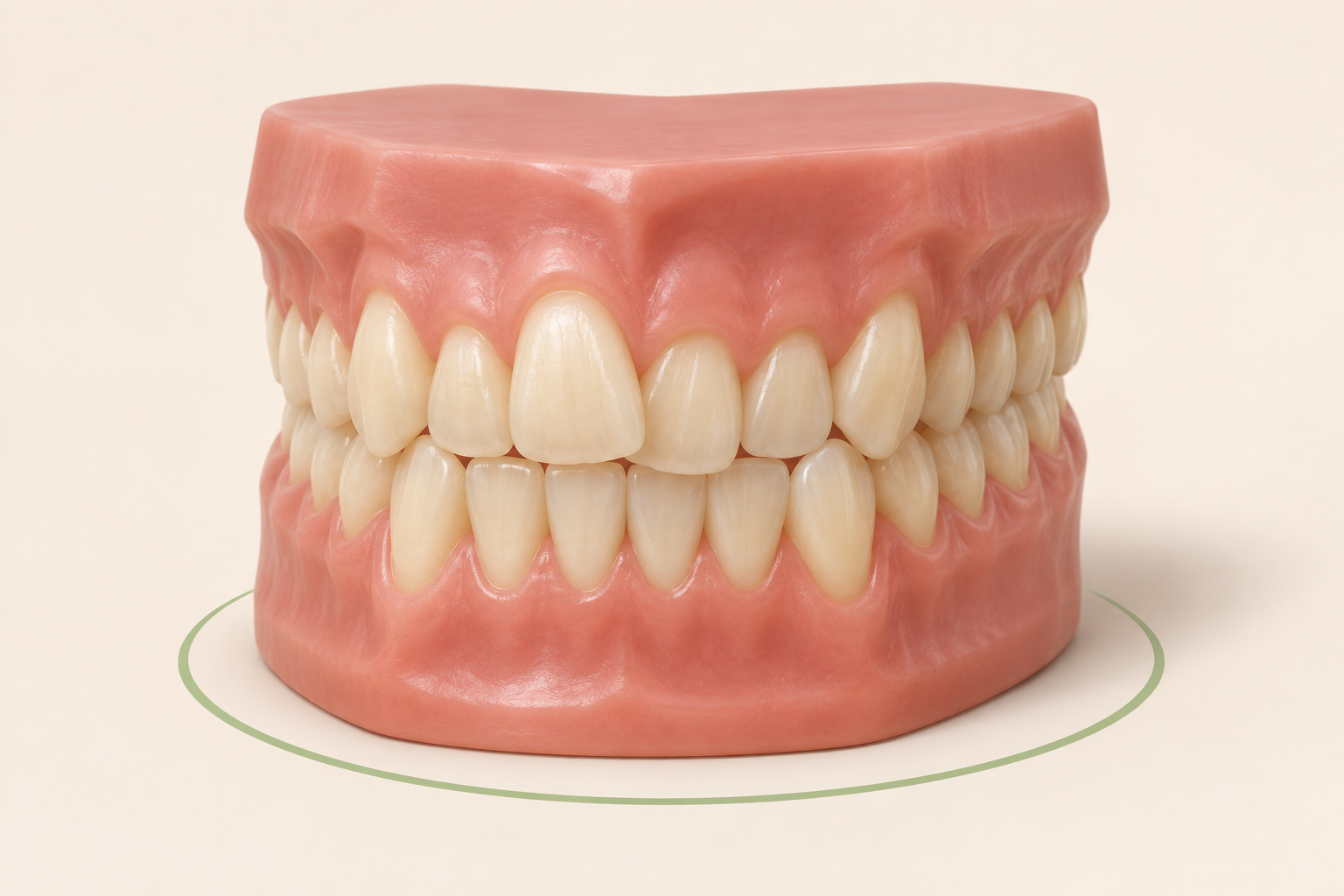
For a lot of adults, it really is just the front teeth.
“I only want to fix this one tooth.”
I hear some version of this almost every week. Usually it comes with a phone held up to show me a photo: a group shot, a video call screenshot, a selfie zoomed in a little too far. Everything looks fine, except that one front tooth that overlaps its neighbor.
So you search “front teeth only braces,” and the internet tells you two things at once: that a quick fix exists, and that you might need full treatment anyway. Both can be true. The difference comes down to a few things you can't see in a selfie.
What's the difference between limited and comprehensive treatment?
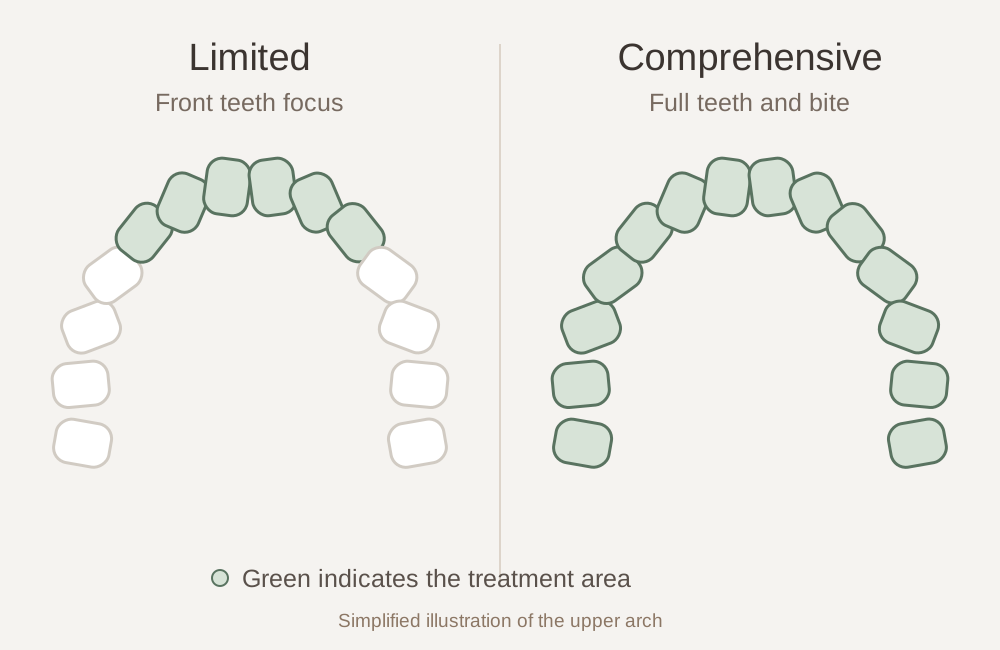
Limited treatment (sometimes called partial braces or front-teeth-only treatment) focuses on a few teeth, usually the front ones you see when you smile. Because fewer teeth move, and over shorter distances, it often takes around six months.
Comprehensive treatment (full treatment) aligns all your teeth and adjusts how your upper and lower teeth fit together. It takes longer, but it can address things limited treatment can't, like a deep bite, a crossbite or teeth that stick out.
| Limited | Full | |
|---|---|---|
| Goal | Straighten the front teeth that bother you | Align all teeth and your bite |
| Teeth involved | A few, mostly in front | Upper and lower, front to back |
| Typical length | Often around 6 months | Longer |
| Changes your profile? | Rarely | Can, depending on the plan |
| Retainers | Essential | Essential |
Am I a good candidate for front-teeth-only treatment?
Limited treatment usually works best when your back teeth already fit together well and your front teeth are only mildly crowded, rotated or gapped. Your concern might be your front teeth, but your back teeth and the space available usually decide the plan. Here's a quick self-check.
Limited treatment may be worth considering if:
- Your back teeth meet comfortably when you bite and chew
- Your front teeth are mildly crowded, rotated or gapped
- You're happy with your profile and the way your lips sit
- You had braces before, and only your front teeth have shifted
Comprehensive treatment may be the better fit if:
- Your teeth stick out and you'd like your profile to change too
- Crowding is severe, or there isn't much room for your teeth
- Your front teeth don't touch when you close your mouth (an open bite)
- Your lower front teeth sit in front of your upper teeth
- The center lines of your upper and lower front teeth are noticeably off
If you checked items on the second list, straightening only the front teeth might leave the underlying bite issue in place. That's why, even when you only point to one tooth, we check your back teeth and your lower teeth too.
Why does my orthodontist check my back teeth for a front-tooth problem?
Because a front tooth needs space to move into, and it has to fit with the teeth beside it and the teeth it bites against. If the space or the bite isn't right, moving the front teeth alone won't give a stable result.
Picture a book leaning sideways on a full bookshelf. To stand it up straight, you first need to check whether there's room between the books next to it. Teeth work the same way: upper teeth meet lower teeth, and front teeth work together with back teeth.
When space is only a little tight, we can sometimes create room by polishing a hair-thin amount of enamel between teeth (called IPR). When space is very tight or the bite is off, the front teeth alone can't solve it.
Your front teeth may be the concern. Your back teeth usually decide the plan.
How long does it take to straighten just your front teeth?
Limited treatment often takes around six months. Comprehensive treatment takes longer, because more teeth move and the bite is adjusted too. Your exact timeline depends on:
- How many teeth need to move, and how far
- How much space is needed, and how we create it
- Your appliance, and with clear aligners, how consistently you wear them
We give you an estimated timeline after your exam. If you have a deadline, like a wedding or a move, tell us at the start so we can plan around it.
Will my teeth shift back after limited treatment?
They can, and front teeth are the most likely to move back. Retainers prevent this: we generally recommend keeping a bonded retainer long-term and wearing a removable retainer consistently for one to two years after treatment. It's the question I wish more people asked first.
After orthodontic treatment, teeth tend to drift back toward where they started. Think of a young tree that's just been replanted: it needs a support stake until its roots settle in. Your teeth need the same thing, and that's what retainers are for.
- Bonded retainer: a thin wire attached behind your front teeth. Nobody can see it, and we generally recommend keeping it long-term.
- Removable retainer: a clear tray you put in and take out. Plan to wear it consistently for one to two years after treatment.
So think of it as “about six months of treatment, plus a retainer routine.” That second part is what keeps your result.
Moving abroad after treatment? Tell us early. We'll make sure you leave with your retainers and full records in English, so an orthodontist in your next city can check on them. More in our International Patients guide.
Is Invisalign the same as limited treatment?
No. Limited vs. comprehensive describes how much of your bite is treated. Clear aligners, braces and lingual braces describe the appliance. You can treat your whole bite with clear aligners, and you can do limited treatment with braces.
The right order is to decide the scope first, then choose the appliance. If you go with aligners, the trays need to be in almost all day, except when you eat and brush. Not sure that fits your routine? Read Am I a Good Candidate for Invisalign?
What happens at a limited treatment consultation in Seoul?
We check whether limited treatment can reach your goal, using a digital scan and an exam of your bite, and explain your options in English. You don't need to decide between limited and comprehensive before you come in. Just bring these:
- The tooth that bothers you: overlap, gap or angle. A photo of you smiling helps a lot.
- How much you want to change: “just this tooth” or “my whole smile.” That shapes the plan.
- Any big dates: a wedding, a move, a new job. We plan your timeline around them.
And if you're comparing quotes from different clinics, ask:
- “Which teeth does each plan move, and why?”
- “Does the price include records, follow-up visits and retainers?”
At your visit we take a digital scan and, when needed, a 3D CBCT. Then Dr. Lee explains in English whether limited treatment can reach your goal, along with your options and a written estimate before you decide anything.
We're a one-minute walk from Isu Station (Lines 4 & 7, Exit 2) in Seocho-gu, Seoul, and open until 9 PM on Mondays and Thursdays, so you can come after work.
Frequently asked questions
How long does it take to straighten just the front teeth?
Limited treatment often takes around six months. It depends on how many teeth need to move, how far, and how much space is needed. We give you an estimated timeline after an exam.
Can I fix just one crooked front tooth?
Sometimes. If your back teeth meet well and there's room to bring that tooth into line, limited treatment may be an option. Even one tooth has to fit with the teeth beside it, so the treatment area is decided after an exam.
Why does the orthodontist check my bottom teeth if only my top teeth bother me?
Because your top and bottom teeth meet when you bite. Moving an upper front tooth can change how it touches the lower teeth, so we look at both.
Is Invisalign the same as limited treatment?
No. Limited or comprehensive describes how much of your bite is treated. Clear aligners, braces and lingual braces describe the appliance. Aligners can be used for either.
Do I really need a retainer after limited treatment?
Yes. Teeth tend to drift back toward where they started, and front teeth are especially prone to it. We generally recommend keeping a bonded retainer long-term and wearing a removable retainer consistently for one to two years after treatment.
I had braces as a teen and my front teeth moved again. Can limited treatment fix that?
Often, if your bite hasn't changed much. This is one of the most common reasons adults come to see us. We'll check what shifted and plan a retainer you can keep using afterward.
Trained in Seoul and Los Angeles.
Dr. Lee earned her PhD in Orthodontics at Yonsei University, trained at Severance Hospital, and completed an exchange residency at the University of Southern California. Today she peer-reviews research for AJO-DO, the official journal of the American Association of Orthodontists, and teaches Invisalign to doctors at university hospitals. When you come in, she’s the one explaining your plan, in English, from your first scan to your final appointment.
Just one tooth bugging you?
Send us a smiling photo. Dr. Lee will tell you whether limited treatment is worth exploring, and what it would take.
Message on WhatsApp Book a VisitWant to compare your options first? See Braces & adult orthodontics and Invisalign & Angel Aligner.
This article is general information and isn't a substitute for an in-person examination. Treatment options, timelines and results depend on each person's teeth, gums and bite. Orthodontic treatment can involve discomfort, gum irritation or root resorption.
Find us in Seoul
One minute from Isu Station.
Isu Yonsei Baro Orthodontic Clinic
4F, Bangbae Yedain Plaza, 118 Dongjak-daero, Seocho-gu, Seoul.
Isu Station · Lines 4 & 7 · Exit 2