
Blog · Adult Orthodontics
Weak Chin? How to Tell a Real Weak Chin from a Hidden One, and How Orthodontics Can Help
Your face looks fine from the front. Then a side photo makes you wonder where your chin went. Before you assume your jaw is just small, it's worth finding out which kind of weak chin you actually have.

November 11, 2026 · 6 min read
The short version
- A “weak chin” often comes from one of two things: lips pushed forward by tilted front teeth, hiding the chin, or a lower jaw rotated down and back.
- If your chin is hidden, moving the front teeth back lets the lips settle and the chin show.
- If your jaw is rotated, mini-screws can move the upper back teeth upward so the jaw swings forward and up.
- Treatment usually takes 18 months to 2 years, with clear aligners or lingual braces.
- For kids, timing matters: growth-guiding treatment only works while they're growing.
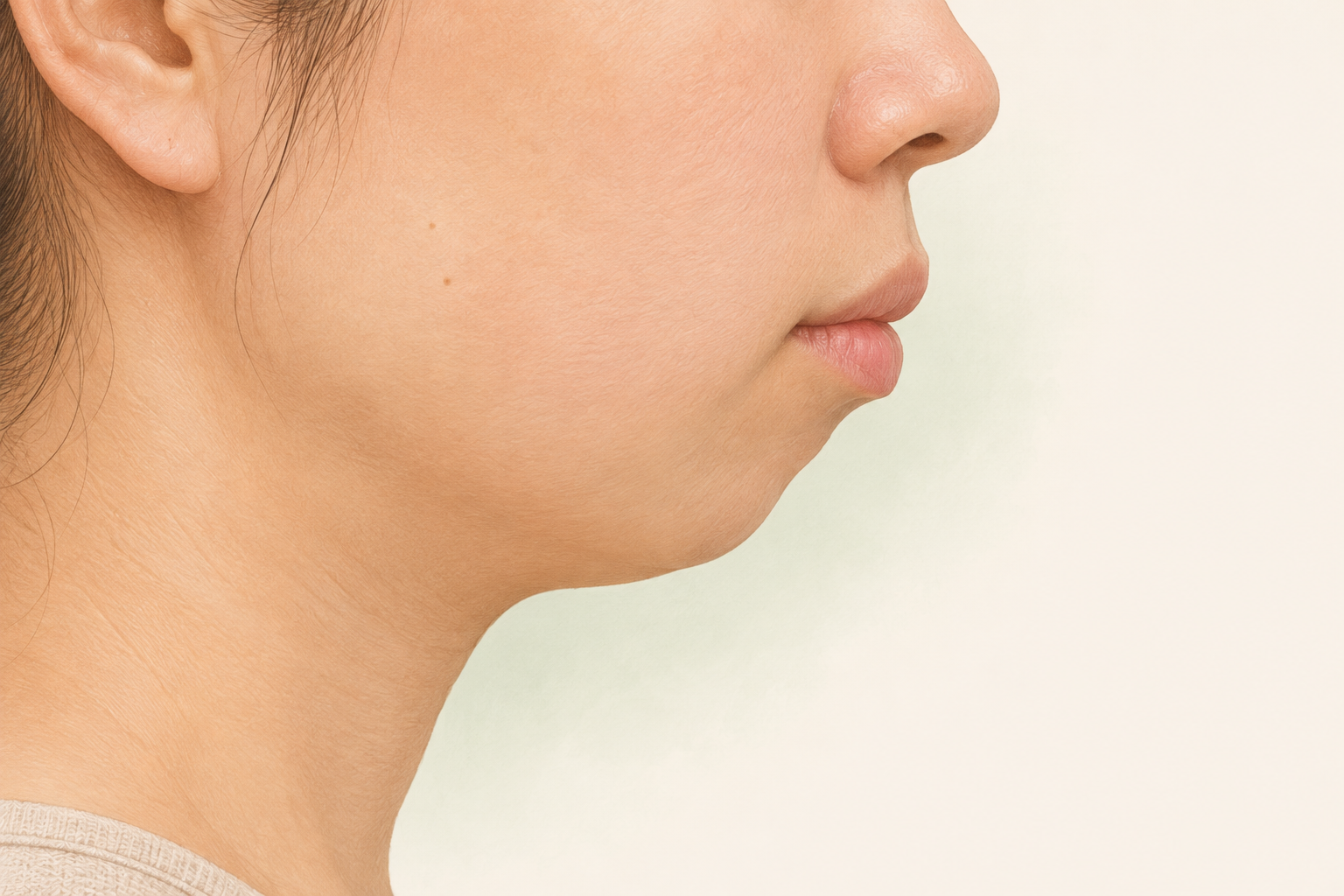
From the side, the chin can seem to disappear. The question is why.
“I have a weak chin. Can orthodontics actually help?”
When adults in Seoul ask me this, I answer with a question of my own: is it a real weak chin, or a hidden one? The answer changes the whole plan.
Can braces fix a weak chin?
Often, yes, depending on what's causing it. If your chin is hidden behind protruding lips, moving the front teeth back can reveal it. If your lower jaw is rotated down and back, mini-screws can help rotate it forward. Profile photos and a side X-ray show us which one you're dealing with.
Real weak chin or hidden chin: how can I tell?
A hidden chin isn't actually small. Your front teeth tilt forward, push your lips out, and the chin gets lost behind them. A rotated jaw is different: the lower jaw sits at an open, down-and-back angle, so your face looks longer and your chin sits further back. Many people have a bit of both.
| What to look at | Hidden chin | Rotated jaw |
|---|---|---|
| When you close your lips | The chin dimples and tenses | Front teeth don't quite touch |
| Face shape | Lips look full and part easily | Face looks long, chin sits back |
| Side view | Lips sit in front of the nose-to-chin line | Short, blurry line from chin to neck |
| Main approach | Move front teeth back | Intrude back teeth with mini-screws |
How do you fix a hidden chin?
By moving the front teeth back so the lips can follow. Picture a curtain bulging out in front of a window frame. Pull the curtain back, and the frame shows. Your lips are the curtain; your chin is the frame.
Once your lips close easily, the chin muscle relaxes and that dimpled, tense look often softens. Making room for the front teeth sometimes means removing a premolar on each side. Read more in Protruding Mouth? Why Straight Teeth Can Still Look Pushed Out.
How can mini-screws move my chin forward?
By gently pushing the back teeth up, which lets the lower jaw close further and swing the chin forward and up. The face looks shorter, and the chin looks stronger.
Your lower jaw opens and closes like a door on a hinge just in front of your ears. Your back teeth act like the doorstop: they decide how far the door can close. If the back teeth are tall, it's like a thick doorstop, and the jaw stays slightly open, down and back. Reducing the height of the back teeth makes the doorstop thinner, so the door closes further.
A weak chin isn't always a small chin. Finding out why it looks weak is where the plan starts.
- Who it's for: people whose face looks long, whose chin sits back, and whose front teeth don't quite meet. It isn't the right approach for every weak chin.
- Mini-screws: tiny orthodontic screws placed under local anesthesia in a few minutes, and removed once they've done their job.
- How much change: it varies. We measure face height, jaw angle and back-tooth height to explain what to expect before you start.
How long does weak chin treatment take?
Usually around 18 months to 2 years, depending on how far the front teeth move, whether extractions are needed, and how much the back teeth need to move up. Both clear aligners and lingual braces can be options, and mini-screws can be used with either. Both are less noticeable than braces attached to the front of the teeth.
What about a child with a weak chin?
If the lower jaw is still growing, growth-guiding appliances can encourage it to grow forward. Because this works with growth, timing matters. If your child breathes through their mouth or their chin looks set back, an orthodontic check in elementary school is a good idea.
What happens at a consultation with a Seoul orthodontist?
You don't need to know the cause or the treatment before you come in. Just tell us, “My chin looks weak in side photos, and it wrinkles when I close my mouth.”
We take a digital scan, profile photos and, when needed, a 3D CBCT. Dr. Lee, an orthodontic specialist certified by Korea’s Ministry of Health and Welfare, explains in English whether you have a hidden chin, a rotated jaw or both, how long treatment would take, and your appliance options, with a written estimate before you decide anything.
We're a one-minute walk from Isu Station (Lines 4 & 7, Exit 2) in Seocho-gu, Seoul, and open until 9 PM on Mondays and Thursdays, plus Saturday mornings.
Frequently asked questions
Can braces fix a weak chin?
Often, depending on the cause. If your chin is hidden behind protruding lips, moving the front teeth back can reveal it. If your lower jaw is rotated down and back, mini-screws can be used to move the upper back teeth upward so the jaw rotates forward. An exam tells us which applies to you.
How long does weak chin treatment take?
Usually around 18 months to 2 years, depending on how far the front teeth move, whether extractions are needed, and how much the back teeth need to be intruded.
Will pushing the back teeth up affect how I chew?
We move the back teeth up slightly and plan the bite so the upper and lower teeth fit together again. The goal is a comfortable bite that lets you chew normally.
Can clear aligners treat a weak chin?
Clear aligners and lingual braces can both be options, and mini-screws can be used with either.
Will the dimpled, tense look on my chin go away?
Often it softens. Once the front teeth move back and your lips close comfortably, the chin muscle doesn't have to strain as much.
When should a child with a small lower jaw be checked?
While they're still growing. Growth-guiding appliances only work during growth, so an orthodontic check in elementary school is a good idea, especially if your child breathes through their mouth or their chin looks set back.
Trained in Seoul and Los Angeles.
Dr. Lee earned her PhD in Orthodontics at Yonsei University, trained at Severance Hospital, and completed an exchange residency at the University of Southern California. Today she peer-reviews research for AJO-DO, the official journal of the American Association of Orthodontists, and teaches Invisalign to doctors at university hospitals. When you come in, she’s the one explaining your plan, in English, from your first scan to your final appointment.
Wondering about your chin?
Tell us what you notice in side photos and what you’d like to understand at your first visit.
Message on WhatsApp Book a VisitWant to compare your options first? See Braces & adult orthodontics and Invisalign & Angel Aligner.
This article is general information and isn't a substitute for an in-person examination. Treatment options, timelines and results depend on each person's teeth, gums, bite and facial features. Orthodontic treatment can involve discomfort, gum irritation or root resorption.
Find us in Seoul
One minute from Isu Station.
Isu Yonsei Baro Orthodontic Clinic
4F, Bangbae Yedain Plaza, 118 Dongjak-daero, Seocho-gu, Seoul.
Isu Station · Lines 4 & 7 · Exit 2